Sundhausen – Jena, Werneuchen, 26th February 2026
Final presentation of the “Q-net-Q” research project at the Sundhausen Health Kiosk in Thuringia, featuring the transmission of patient data to Jena University Hospital via a temporary telemedicine network secured by quantum key distribution (QKD)
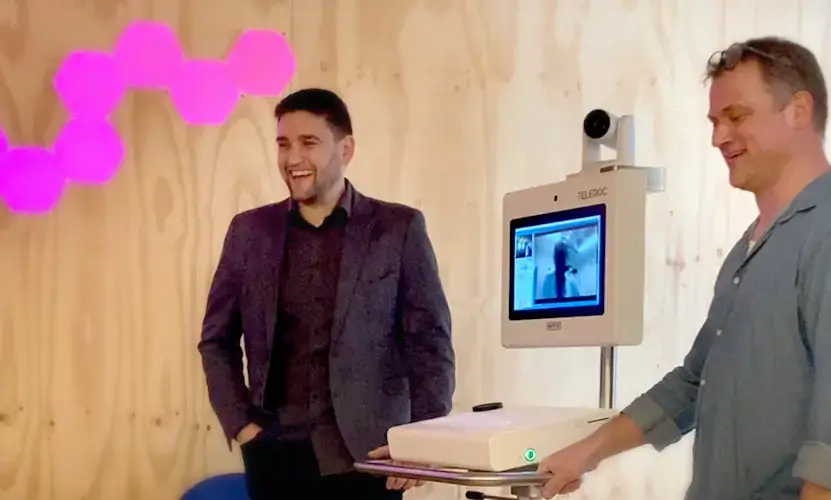
Presentation of a secure quantum infrastructure for telemedicine: an example of a real-time connection with Dr Günther from the UKJ via the quantum-secured test link from Sundhausen to Jena
As part of a presentation marking the conclusion of the “Q-net-Q” research project at Nordhausen University of Applied Sciences (HSN), which focused on the integration of QKD into ICT networks, the secure exchange of patient data via a fibre-optic network using quantum key distribution (QKD) was successfully demonstrated at the Sundhausen Health Kiosk on 26 February 2026. By using this form of quantum communication, the defence against cyberattacks during data transmission can be raised to a previously unattainable level and thus also guaranteed in the future.
Due to the rapid advancement of quantum computing, conventional methods for establishing secure connections over insecure networks – such as those currently used on the internet – are at risk of becoming obsolete. In contrast, there is the development of QKD systems, such as those used during the presentation at. These systems utilise an effect known as ‘quantum entanglement’ to generate key material at both ends of the fibre-optic connection, which, according to the laws of physics, cannot be intercepted by any potential attacker without being detected. This technology could therefore become a key factor in highly secure telemedical communication.
During the field trial, telemedicine systems from MEYTEC, such as the TELEDOC 6, were used at the Sundhausen Health Kiosk and at Jena University Hospital. A live connection was established with Jena University Hospital via a quantum access point, encrypted for security. There, Dr Albrecht Günther, Senior Consultant in Neurology at the UKJ, was able to conduct a video call with those present in Sundhausen using a computer.
The project’s results clearly demonstrate that the use of this new security technology could prove to be a game-changer for the networking of hospitals. Gerhard W. Meyer, Managing Director of MEYTEC GmbH, commented: “Telemedicine requires data exchange of the highest security. Quantum communication should therefore be introduced gradually for the networking of hospitals that form part of critical infrastructure (KRITIS).”
About MEYTEC
Since 2002, MEYTEC has established itself as a provider of innovative telemedicine solutions for pre-clinical, clinical and post-clinical applications and possesses extensive expertise in this field. Expertise and years of experience have since been channeled into the development and refinement of the company’s own systems, solutions and services in close collaboration with medical users and technology partners.
info@meytec.com | T. +49 333 98 78 200
meytec.de
About Nordhausen University of Applied Sciences
Nordhausen University of Applied Sciences, under the leadership of Prof. Dr.-Ing. Thomas Hühn, acted as the consortium leader for the “Q-net-Q” research project. In collaboration with six technology partners from the research and industrial sectors, the project evaluated a systematic technology transfer between the technology domains of QKD and ICT, taking into account the relevant IT security aspects. The project was implemented as part of the European EuroQCI programme. The EU and the BMFTR funded the project.
hs-nordhausen.de